

I am looking to earn my

Master of Science in Software Development

Classroom to Career

The Master of Science in Software Development program at American National University is designed for professionals who want to deepen their expertise in designing, building, and managing modern software solutions. Offered in a flexible online format, the program emphasizes the full software development lifecycle, from evaluating business and technical problems to translating requirements into secure, reliable, and maintainable applications. Students develop strong skills in requirements analysis, software design, and system modeling, enabling them to gather customer needs and create diagrams and models that guide effective coding and implementation. The program places a strong focus on collaborative development, preparing students to work and communicate effectively within software development teams, including agile and distributed environments. Students also learn best practices for documenting software applications to support testing, maintenance, and future enhancements. To support leadership and project execution within software development contexts, the core requirement PM510 aligns with PMI’s PMP certification and strengthens students’ ability to manage software projects, coordinate development efforts, and deliver solutions on time and within scope. Graduates of the program are prepared to advance into software development and technical leadership roles that require both hands-on development skills and the ability to manage complex software initiatives.

Upon completion of the Master of Science in Software Development program, you should be able to:

  • Evaluate a business or technical problem and understand the requirements of developing a solution.
  • Work and communicate effectively in a software development team environment.
  • Effectively design software solutions that are secure and reliable.
  • Gather requirements from customers and create a variety of diagrams and models that programmers could use to write the software code.
  • Document aspects of software application as a reference for future maintenance upgrades.

Check out our “Not-What-You-Would-Expect” Guide to Technology to learn more about this high-demand field.
Online Tuition Comparison

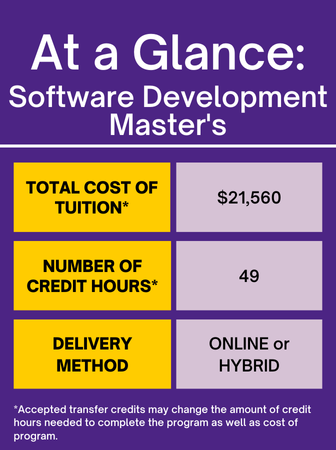
Total tuition for a master’s degree in Software Development at ANU is only $21,560. Large online colleges with course-based programs are 18% – 112% higher and do not include fees or textbooks.(1) ANU tuition includes all fees (application, course, technology, graduation, etc.), textbooks, and lab equipment (where applicable).

Course Information

Master of Science in Software Development: 49 Credits

GLOBAL LEARN CLASSES

MSD Courses

OFFERED TIMES

8 hours, once per term on Saturday

In-person Residency is 3 days per term on Friday, Saturday, and Sunday (For International Students only)

Program Core: 49 Credits

In this course, students acquire information retrieval skills and research competencies to identify and evaluate industry-relevant sources of information for the purposes of analysis and research information security. Students compare and contrast the utility of publicly available and subscription-based information sources for the purposes of meeting academic and professional requirements.

(Co‐Req. RM525) In this course, students will explore database design, development, data warehousing, and the usage of data specification. Students will explore how to generate, patch, and reverse engineer databases utilizing the Entity Relationship Diagram (ERD). This course also includes Best Practices in database design and management as well as usage of data specifications.

(Pre-Req. RM525) In this course, students will explore computer architecture and various operating systems. Students will explore processing, storage, networking, monitoring, and the inner workings of how operating systems are configured and communicate with other computers and server-based systems.

(Pre-Req. RM525) In this course, students will learn how to apply the methods and techniques for creating software systems using the best practices in modeling, architecture, process analysis, design, and object-orientated design patterns. This course will provide students with the principles and concepts involved in the analysis and design of large software systems.

(Pre-Req. RM525) In this course, students will learn how to apply the best practices for large-scale software system engineering, including information security, user interface, architectural design, system models, verification, and validation. Students will strengthen their technique and deepen their understanding of high-level languages and system programming.

(Pre-Req. RM525) In this course, students will how to apply the best practices in software architectural design, including object orientated design techniques, design reviewing, software design patterns, UML, OCL, and applying various architectural styles, methods, and techniques. This course will provide students with the skills required to face the increasingly complex future in architecting systems, systems of systems and software-intensive systems.

(Pre-Req. RM525) In this course, students evaluate the principles, attributes and processes used in

designing and deploying a comprehensive and resilient layered security architecture that supports the business and technical objectives of the enterprise.

(Pre-Req. RM525) In this course, students utilize PMI’s Project Management Body of Knowledge (PMBOK) as a framework, to apply project management concepts in the information security arena. Each student develops a project plan for a security assessment, which incorporates the technical and behavioral characteristics of high-performance teams.

(Pre-Req. RM525) In this course, students will develop a comprehensive, synthesizing project that applies the knowledge and skill set that has been learned in previous course work that comprises the software development program. Projects must have an academic and an applied component.

Electives – Select 3

(Pre-Req. RM525) In this course, students will be introduced to various aspects of Java programming logic. This will include logical form areas such object-oriented, transaction, linear, and other such programming concepts and procedural program writing using variables, arrays, control statements, loops, recursion, data abstraction, and objects.

(Pre-Req. RM525) In this course, students will be introduced to various aspects of NoSQL programming logic and what distinguishes it from traditional database systems. We will explore the relationship between data’s big data storage needs and the development and growth of NoSQL as an example of a non-relational database.

(Pre-Req. RM525) This course is designed to introduce students to the C programming language. Students will learn concepts such as functional abstraction, the object-oriented programming paradigm and application programming Interfaces (APIs). Students will learn how to write procedural programs using variables, arrays, control statements, loops, recursion, data abstraction and objects in an integrated development environment.

(Pre-Req. RM525) In this course, students will be introduced to various aspects of Python programming logic. This will include logical form areas such object-oriented, transaction, linear, and other such programming concepts and procedural program writing using variables, arrays, control statements, loops, recursion, data abstraction, and objects.

Review the TECHNOLOGY REQUIREMENTS for blended and online programs.

Dr. Richard Lightcap

Dean of Information Technology Programs

 Build the foundation of your goals at American National University.

Translate »