

Choose Your Path

I am looking to earn my

Phlebotomy and ECG Technician Diploma

Classroom to Career

Take the opportunity to gain a greater understanding of the concepts, organization structures and strategies driving today’s complex organizational environment.

Upon completion of the Phlebotomy and ECG Technician Diploma program, you should be able to:

  • Perform an ECG and interpret cardiac rhythms and dysrhythmias.
  • Function as an entry‐level ECG technician with the necessary knowledge, skills, and professional behavior.
  • Perform venipuncture and capillary puncture following proper protocol.
  • Function as an entry level phlebotomist with the necessary knowledge, skills and professional behavior.
  • Apply legal concepts by performing with legal and ethical boundaries; preparing and maintaining medical records; and documenting accurately and appropriately and communicate effectively.
Course Information

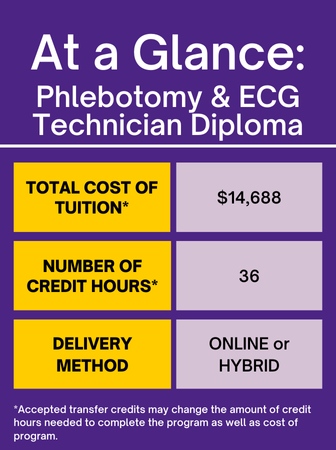
Phlebotomy and ECG Technician Diploma: 36 Credits

GLOBAL LEARN CLASSES

Phlebotomy & ECG Courses

OFFERED TIMES

2 Hours Every Other Week

Evening classes are scheduled between 6 and 10 pm, EST

Program Core: 36 Credits

A study of the anatomy, physiology and medical terminology of the skeletal, muscular, respiratory, cardiovascular, lymphatic, immune, hematological, digestive, and reproductive systems. This course covers human development, birth and genetics.

A study of the anatomy, physiology and medical terminology of the cell, tissues, membranes, and structures of the nervous system, the sensory system, the integumentary system, the digestive, the urinary system, and the endocrine system. This course will discuss the basic chemistry, water acids, bases, carbohydrates, lipids, proteins, nucleic acids and classes of macromolecules in cells.

This is an introductory course that provides a comprehensive study of The Microsoft Office. This course is a combination of lecture and hands-on training.

Introduction to law and ethics pertinent to medical careers. Topics include legal issues that are important to health care professionals, including the foundations of law and ethics as well as professional, social, and interpersonal health care issues.

Effective communication is a critical skill for the healthcare professional. This course provides the basic skills to communicate orally and in writing within an interdisciplinary, multicultural, and multigenerational healthcare environment. The essentials of communication and the “soft-skills” needed for entry level healthcare jobs and career success are taught.

This course provides an introduction to the tools and skills used in the physician’s office laboratory by the Medical Assistant. Examples of skills taught are blood specimen collections including: venipuncture and capillary puncture; injection procedures; basic hematological procedures; clinical chemistry, and immunologic testing in the CLIA-waived laboratory. Instruction are given in medication administration and diagnostic testing.

Instruction will be provided regarding OSHA compliance with blood-borne (and airborne) pathogen; urinalysis procedures; basic microbiological principles and procedures; diagnostic imaging; nutrition for health and disease; spirometry test, and electrocardiography. The basic elements of nutrition and dietary management will be reviewed. Principles of ergonomics and therapeutic modalities will be taught and practiced as well.

This course is designed to prepare the student for success with the National Certified Phlebotomy Technician (NCPT) and National Certified ECG Technician (NCET) examinations. Instruction will be provided through a structured classroom review and testing to assess and support the student’s recall of materials presented throughout the program. This is a capstone course that culminates with the student completing the certification exams.

This course provides students with the opportunity to receive hands-on experience in phlebotomy and with electrocardiography. Course work includes 120 clock hours of on-site experience under the supervision of the facility’s staff and/or Director of Health Science Education.

Note(s):

For all courses: See course description for applicable prerequisites.

For program disclosure information, please visit

Consumer Disclosure

Clinical Hours

A clinical externship is required to gain real-world work experience. See if there is an existing clinical site in your local area.

Certifications

Graduates of the program are eligible to sit for these certification exams:
  • Certified Phlebotomy Technician (CPTC)
  • Certified EKG Technician (CET)
Review the TECHNOLOGY REQUIREMENTS for blended and online programs.

Laura Diggle

Program Chair of Health Sciences

Welcomes you to the Health Sciences Department.

 Build the foundation of your goals at American National University.

Translate »