
Choose Your Path

I am looking to earn my

 Network Administration Bachelor’s

Classroom to Career

The Bachelor of Science in Network Administration program at American National University prepares students for professional roles as network administrators and computer systems analysts in today’s technically complex business and government environments. The program develops the hands-on skills and technical knowledge required to design, deploy, administer, and maintain PC-based networks that support organizational operations. Students learn to assign and manage routing protocols and routing tables, ensure reliable LAN and WAN connectivity, and deploy network infrastructures that align with business and technical requirements. The curriculum emphasizes server administration in site-to-site environments, including maintaining file servers, VPN gateways, intrusion detection systems, and directory services, as well as configuring authentication and authorization controls. Students apply critical thinking and problem-solving skills to troubleshoot network issues, respond to user needs, and support technical staff throughout all phases of network installation and operations. A strong focus is placed on implementing and maintaining network security procedures to preserve the integrity of network and server deployments across multi-platform environments. The program is aligned with recognized industry certifications, including CompTIA A+ through IT101 and IT102, CompTIA Network+ through IT110 and IT111, and CompTIA Security+ through CY200, reinforcing essential competencies in hardware, networking, and security fundamentals. Advanced server administration and infrastructure skills are developed through coursework aligned with Windows Server 2022, including NET205, NET227, and NET228. Graduates of the program are well prepared to pursue careers in network administration and systems analysis and to continue professional growth through industry-recognized certifications and advanced technical roles.

Upon completion of the Network Administration Bachelor’s program, you should be able to:

  • Assign routing protocols & routing table configuration.
  • Administer & maintain a PC based network for companies.
  • Ensure network connectivity throughout a company’s LAN/WAN infrastructure is on par with technical considerations.
  • Manage servers in a site-to-site local environment.
  • Maintain network servers such as file servers, VPN gateways, and intrusion detection systems.
  • Implement Network security procedures and maintain network security.
  • Apply critical thinking & problem solving to support & troubleshoot network environments.
  • Assist technical support staff & network users through all phases of troubleshooting and installation of network services.
  • Respond to user needs in a PC based network.
  • Assign configuration of authentication and authorization of directory services.
  • Maintain integrity of the network, server deployment, and security.
  • Deploy a PC based network in accordance with the needs of a business.
  • Manage server technologies across a multi-platform environment.

Check out our “Not-What-You-Would-Expect” Guide to Technology to learn more about this high-demand field.

Online Tuition Comparison

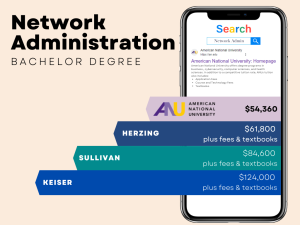
Total tuition for an bachelor’s degree in Network Administration at ANU is only $54,360. Large online colleges with course-based programs are 14% – 128% higher and do not include fees or textbooks.(1) ANU tuition includes all fees (application, course, technology, graduation, etc.), textbooks, and lab equipment (where applicable).

Course Information

Network Administration Bachelor’s (NET-B): 180 Credits

GLOBAL LEARN CLASSES

Network Administration Courses

OFFERED TIMES

2 Hours Every Other Week

Evening classes are scheduled between 6 and 10 pm, EST

Program Core: 92 Credits


  • COM151 The Microsoft® Office

This course provides a vendor‐neutral survey of Relational Database Management Systems Technology. Students will study the relational model and relational design including E‐R diagramming and normalization techniques. The course introduces the student to Query‐By‐Example (QBE) and Structured Query Language (SQL) and introduces the fundamentals of database administration and management, data integrity and data security.

(Prereq.– NET205) Students taking this course are introduced to the analyses, methodology and tools used to translate business requirements into information systems that support the short‐ and long‐ term objectives of the enterprise. Students will learn about traditional structured analysis, object‐ oriented concepts and agile methods and the Systems Development Life Cycle (SDLC). They are also introduced to project management concepts and the software tools most commonly used by systems analysts.  

(Prereq.– IT110 and IT111) This course provides students with the knowledge and skills necessary to understand the core concepts of computer and network security. This course explains key security concepts including understanding threats to a computing infrastructure, securing a network infrastructure, understanding encryption technologies, securing communication and applications, and responding to security incidents. This course is designed to help prepare students for the CompTIA Security+ Certification Examination.

Students taking this course will obtain a background in digital electronics, digital devices, digital circuits, safety, digital security, and will obtain an introduction to networking.  

(Prereq.—IT100) This course is designed to prepare students for the CompTIA A+ Certification software examination. Topics include operating system fundamentals; operating system architecture; comparison of operating systems; the boot process; installing, configuring, supporting, and upgrading operating systems; diagnosing and troubleshooting operating systems, and file systems. Students will also be introduced to networking, hard drive support, and Internet concepts and configurations as related to operating systems. At the conclusion of the course students will sit for the CompTIA A+ Certification software examination.  

(Prereq.—IT100) This course is designed to prepare students for the CompTIA A+ Practical Application Hardware Certification examination. Students taking this course will develop the knowledge and hands‐on skills necessary to install, troubleshoot, service, and support microcomputer hardware. At the conclusion of the course students will sit for the CompTIA A+ Hardware examination.  

Hours   (Prereq.—IT101) Students taking this course will prepare for the CompTia Net+ certification. The will use their knowledge of networking technology for local area networks (LANS), wide area networks (WANS), and the Internet.  

(Prereq.— IT110) Students taking this course will obtain an understanding of networking technology for local area networks (LANS), wide area networks (WANS), and the Internet. As well as prepare them for the CompTia NET+ certification.  

(Prereq.—IT102) Students taking this course will obtain the knowledge and skills necessary to implement, administer, and troubleshoot a desktop operating system in a network environment. This course aligns with the objectives in the Microsoft certification for client configuration.  

(Prereq.—IT102)   Students taking this course will obtain the knowledge and skills necessary to implement, administer, and troubleshoot a desktop operating system in a network environment. This course aligns with the objectives in the Microsoft certification for client configuration.  

(Prereq.—IT110, IT111) Students taking this course will obtain a strong foundation in each aspect of computer networking. This course aligns with the objectives in the ICND1 blueprint from Cisco Systems.

(Prereq.—IT220) Students taking this course will obtain a strong foundation in each aspect of computer networking. This course aligns with the objectives in the ICND2 blueprint from Cisco Systems.  

Hours   (Prereq.– IT111) Students taking this course will build the skills and knowledge necessary to effectively deploy, manage and administer servers and clients using the Linux operating system in the enterprise and to effectively integrate devices using Linux based operating systems into the enterprise network.  

(Prereq.– NET229) Students in this course will explore a unifying paradigm for understanding operations based on the design and management of business process. They will learn how managers can control process structure and process drivers to achieve desired business process performance and understand which level managers have to control: cycle‐time, capacity, inventory and quality.  

(Prereq.—NET205) Students taking this course will develop skills in project integration, scope, time, cost, quality, human resource, communications, risk, procurement and stakeholder management as well as planning, executing, monitoring, controlling and closing processes. This course emphasizes the principles distinctive to managing information technology projects that extend well beyond standard project management requirements.  

(Prereq.—IT111) This course provides students with a broad understanding of Microsoft Windows Server 2016 as well as the knowledge and skills necessary to plan, implement, administer, and troubleshoot Windows Server 2016 in an Active Directory domain environment.  

(Prereq.—NET205) Students taking this course will build the skills and knowledge necessary to implement a core Windows Server 2016 infrastructure in an enterprise environment. This course focuses on implementing, managing, maintaining, and provisioning services and infrastructure using Windows Server 2016. It covers the initial implementation and configuration of core services, such as Active Directory Domain Services, networking services, and Hyper‐V configuration.  

(Prereq.—NET205) Students taking this course will build the knowledge and skills necessary to implement a core Windows Server 2016 infrastructure in an enterprise environment. This course focuses on mastery of core services such as user and group management, network access, and data security.

(Prereq.—NET205) Students taking this course will build the skills and knowledge necessary to implement advanced Windows Server 2016 Services in an enterprise environment. This textbook focuses on mastery of fault tolerance; load balancing, failover clustering, certificate services and identity federation.

(Prereq.– NET229) This is first of two courses covering the planning, design and deployment of a physical and logical Windows Server 2016 Active Directory Domain Services infrastructure. Students taking this course will gain the knowledge and skills to perform name resolution, application integration, optimization and automatic remediation and maintenance of network services. This course maps to the Microsoft Certified Solutions Expert (MCSE) Cloud Platform and Infrastructure certification credential.

(Prereq.– NET300) This course focuses on how to secure Windows Server 2016. Students will learn methods and technologies for hardening server environments and securing virtual machine infrastructures using Shielded and encryption‐supported virtual machines and Guarded Fabric.  This course maps to the Microsoft Certified Solutions Expert (MCSE) Cloud Platform and Infrastructure credential. 

(Prereq. – This course can only be taken during the last two terms of a student’s program) This course helps students create project plans, assemble and lead problem‐solving teams, eliminate or manage potential stumbling blocks, and complete projects on time and within budget.

Electives (Select 8): 32 Credits

(Prereq.– ENG090, if applicable) Students taking this course will develop the skills necessary to produce clear and effective technical documents and reports.  

(Prereq.—IT111) Students completing this course will be able to understand concepts that a service and help desk use to solve simple to complex computer and server issues. These issues will be addressed using phone, remote services, and face to face interaction. Upon completion of the course the student will have also acquired skills necessary to measure performance and manage a service and help desk environment.  

(Prereq.– IT110, IT111) This course introduces students to multiple areas of application development while stressing Python style, best practices and good programming habits. The course covers application development for clients and servers, databases, interfacing with popular Microsoft Office applications, the World Wide Web, the cloud and social media.  

(Prereq.– CY200) This course provides a practical survey of both the principles and practice of cryptography in computer security. Students are introduced to the basic concepts of cryptography and their use in protecting data and resources from disclosure, to guarantee the authenticity of data and messages, and to protect systems from network‐based attacks.  

(Prereq.– CY200) Students in this course will learn the basic strategies and tools used for developing a business case for information security/information assurance governance and will learn how to develop and implement a strategy to increasingly integrate assurance functions to improve security, lower costs and ensure the preservation of the enterprise and its ability to operate.  

(Prereq.– IT310) Managing innovation – a critical skill set in today’s technical enterprise requires skills and knowledge that are significantly different than the traditional management toolkit and experience. Students in this course will learn a complete framework for thinking about innovation across technological, market and organizational perspectives, while integrating the latest developments in the field.  

(Prereq.– NET229) Students taking this course will obtain the knowledge and build the skills necessary to install, configure, and administer Microsoft SharePoint 2013 in the enterprise. The course also covers managing and monitoring sites and users. This course is designed to help students prepare for and pass Microsoft Certified Technology Specialist examination 70‐331.

(Prereq.– NET205) This course provides students with an introduction to Voice over Internet Protocol (VoIP) and emerging Unified Communication technology. Students will learn the component technologies, how they work, how they work together and how to employ them profitably in the enterprise.  

This introductory course in modern business focuses on basic business terms, business concepts, organization structures, and the functions of business.

Students taking this course will learn how interpersonal relationships develop in an organization and how the organization deals with both formal and informal power structures. Topics for discussion include motivation, leadership, organizational environment, and communication.  

General Education: 56 Credits (At least 1 from each discipline) a minimum of 5 must be 300-400 level courses.

Written and Oral Communication

ENG102 English Composition*

ENG126 Oral Communication

Mathematics, Statistics, and Logic

LOG215 Thinking Critically

LOG357 Logic and Critical Thinking*

MAT101 Understanding Mathematics

MAT220 Algebra and Basic Statistics

129

MAT214 Algebra*

MAT419 Introduction to Statistics

Arts and Humanities

ETH205 Ethics

GEN241 Cultural Appreciation

REL330 World Religion

Social and Behavioral Sciences

GOV340 American Government

HIS290 American History 1945–Present

HIS490 American Economic History

POL202 Political Science

PRO453 Parliamentary Procedures/Group Dynamics

PSY127 Psychology*

PSY200 Human Growth and Development

SOC103 General Sociology

SOC463 Social Problems

Physical/Natural Science

BIO101 Introduction to Biology

CHM105 General, Organic Biochemistry

ENV101 Environmental Science

PER330 Personal Health

Note(s):

For all courses: See course description for applicable prerequisites.

* This program requires this General Education course or equivalent

For program disclosure information, please visit https://an.edu/about-us/consumer-disclosure

Review the TECHNOLOGY REQUIREMENTS for blended and online programs.

Dr. Richard Lightcap

Dean of Information Technology Programs

(1) Online tuition pages on the internet at:

 Build the foundation of your goals at American National University.

Translate »