
Choose Your Path

I am looking to earn my

Medical and Health Services Management Bachelor’s

Classroom to Career

Take the opportunity to gain a greater understanding of the concepts, organization structures and strategies driving today’s complex organizational environment.

Upon completion of the Medical and Health Services Management Bachelor’s program, you should be able to:

  • Provide management and leadership in health care organizations by developing management and leadership skills within their area of practice.
  • Utilize knowledge of research to provide evidence based practice.
  • Utilize knowledge of healthcare economics, law, bioethics, and healthcare policy within their practice setting.
  • Develop skills and knowledge to provide quality improvement within their practice setting.

Check out our “Not-What-You-Would-Expect” Guide to Healthcare Administration to learn more about this high-demand field.

Course Information

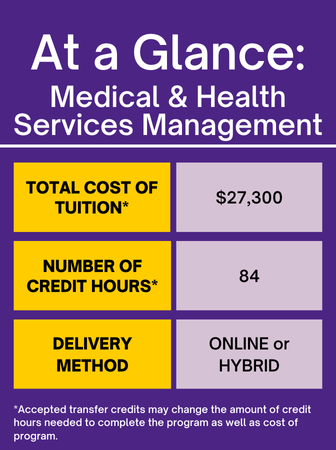
Medical and Health Services Management (MHSM): 180 Credits

GLOBAL LEARN CLASSES

MHSM Courses

OFFERED TIMES

2 Hours Every Other Week

Evening classes are scheduled between 6 and 10 pm, EST

Program Core: 52 Credits

This course is intended to provide a systematic understanding of organizational principles, practices, and insights pertinent to the management of health service organizations. Topics include organizational design as it relates to healthcare organizations, managing professionals, and diversity in the workplace. Topics include the essential role of human resources management within health care organizations with a comprehensive foundation for all aspects of human resources planning, development, and administration and are vital to human resources professional in the healthcare organization.

An overview of medical insurance, coding, documentation guidelines, and billing procedures for health care facilities. Students also learn methods for establishing sound accounts receivable and collection policies, and maintaining compliance with HIPAA and privacy regulations.

This course focuses upon the daily operations and management of medical practice settings, including, but not limited to: physician practices; outpatient surgery centers, and urgent care centers.  This course will also focus upon financial management and regulatory compliance with the reimbursement and operations regulations applicable to the different types of medical practice organizations.

This course expands upon health care law and broadens the scope of traditional bioethics by investigating the social, economic, public policy, and the legal issues affecting healthcare delivery. Students examine the rudimentary basics of the law as it pertains to healthcare management, healthcare laws, and bioethics.

This course provides a systematic study of economic issues pertaining to the health care field. Coursework focuses on basic economic tools, supply and demand, information and insurance markets, key players in the healthcare sector, social insurance, and distinct health care topics.

This course is an introduction of the methods used to define, describe, recognize and apply total quality management in health care. The principles of the quality assessment process will be emphasized. The course will provide an opportunity for the student to gain skills in collecting and analyzing data through a team approach.

This course is designed for health science students in multiple disciplines. Students will learn principles of inter-professional collaboration by developing inter-professional competency skills. Inter-professional collaborative practice is essential to the provision of safe, high quality patient-centered care. This course will introduce learners to the concept of inter-professional collaborative practice and the evidence base that supports its effectiveness. Topics will focus on the roles of various healthcare professionals, their scope of practice, and settings in which they work, communication strategies, tools for effective inter- professional collaborative practice, conflict management, negotiation, the concepts and strategies of leadership and membership to promote effective inter-professional teamwork.

This course covers concepts of healthcare classification systems and terminologies, charge master management, revenue cycle and audit processes. Additional topics include utilization and resource management, and application and analysis of the relationship between clinical code assignment and reimbursement.

This course addresses the analysis of data to make decisions, which includes healthcare statistics, data analysis, mining, and exploration. Collection, evaluation and interpretation of health care data will be covered. Software to analyze data and information related to clinical systems in healthcare will be utilized.

This course is structured to provide students with an overview of healthcare policy, finance, and regulatory issues at the local, state, national, and global level. Concepts will be examined related to the regulatory agencies effect on patient care and scope of nursing; implications of policy and legislative processes on healthcare delivery and vulnerable populations; and the financial implications for healthcare services. Social, ethical, and political issues and policy decisions affecting healthcare and nursing practice will be analyzed. 

This course introduces students to the fundamentals and principles of the research process and how it applies to healthcare. The importance of searching relevant literature, understanding research methods, reviewing research, understanding, and evaluating research findings is emphasized in this course. The utilization of research for evidence based practice is a primary focus of this course.

This capstone course focuses on leadership development in healthcare. Concepts of change management and leadership styles are included. Students will focus on leadership competencies and skills.

This course helps students create project plans, assemble and lead problem-solving teams, eliminate or manage potential stumbling blocks, and complete projects on time and within budget.

Transfer Credit 72 credits transferred from an accredited allied health or nursing program if the student has an associate degree. (Additional transfer credits may be awarded based on individual student associate degree)

Note(s):

For all courses: See course description for applicable prerequisites.

*This program requires this general education course or its equivalent

For program disclosure information, please visit https://an.edu/about-us/consumer-disclosure

General Education: 56 total credit hours required ‐ 24 credits transferred from an accredited allied health or nursing program. The remaining 32 credits must be taken from those below with a minimum of (5) 300‐400 level courses.

Written and Oral Communication

ENG102 English Composition

ENG126 Oral Communication

Mathematics, Statistics, and Logic

LOG215 Thinking Critically

LOG357 Logic and Critical Thinking

MAT101 Understanding Mathematics

MAT214 Algebra

MAT220 Algebra and Basic Statistics

MAT419 Introduction to Statistics*

Arts and Humanities

ETH205 Ethics

GEN241 Cultural Appreciation

REL330 World Religion

Social and Behavioral Sciences

GOV340 American Government

HIS290 American History 1945–Present

HIS490 American Economic History

POL202 Political Science

PRO453 Parliamentary Procedures/Group Dynamics

PSY127 Psychology

PSY200 Human Growth and Development

SOC103 General Sociology

SOC463 Social Problems

Physical/Natural Science

BIO101 Introduction to Biology

BIO201 Basic Anatomy & Physiology I

BIO202 Basic Anatomy & Physiology II

CHM105 General, Organic Biochemistry

ENV101 Environmental Science

PER330 Personal Health

Review the TECHNOLOGY REQUIREMENTS for blended and online programs.

Laura Diggle

Program Chair of Health Sciences

Welcomes you to the Health Science Department.

 Build the foundation of your goals at American National University.

Translate »