
Choose Your Path

I am looking to earn my

Medical Assisting Certificate

Classroom to Career

Take the opportunity to gain a greater understanding of the concepts, organization structures and strategies driving today’s complex organizational environment.

Upon completion of the Medical Assisting Certificate program, you should be able to:

  • Apply legal concepts by performing with legal and ethical boundaries; maintaining confidentiality, preparing and maintaining medical records; documenting accurately and appropriately; following the employer’s established policies dealing with the health care contract; implementing and maintaining federal and state health care legislation and regulations; complying with established risk management and safety procedures; recognizing professional credentialing criteria and the impact personal ethics and morals have on delivery of healthcare.
  • Provide instruction for individuals according to their needs; explain office policies and procedures; teach methods of health promotion and disease prevention; and locating community resources for dissemination of information.
  • Perform operational office functions by performing an inventory supplies and equipment; perform routine maintenance of administrative and clinical equipment; and applying computer techniques to support office operations.
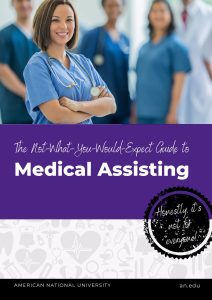
Check out our “Not-What-You-Would-Expect” Guide to Medical Assisting to learn more about this high-demand field.

Online Tuition Comparison

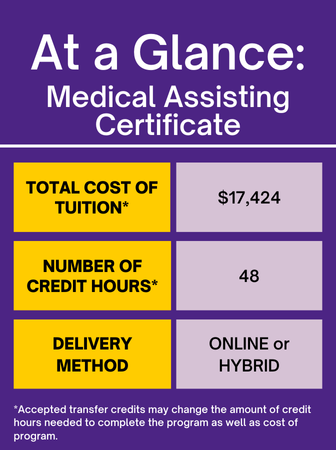
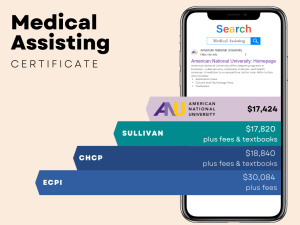
Total tuition for an certificate in Medical Assisting at ANU is only $17,424. Large online colleges with course-based programs are up to 72% higher and do not include fees or textbooks.(1) ANU tuition includes all fees (application, course, technology, graduation, etc.), textbooks, and lab equipment (where applicable).

Course Information

Medical Assisting Certificate (MAC): 48 Credits

GLOBAL LEARN CLASSES

Medical Assisting Courses

OFFERED TIMES

2 hours Every Other Week

Evening classes are scheduled between 6 and 10 pm, EST

Labs occur during course sessions.

Program Core: 48 Credits

A study of the anatomy, physiology and medical terminology of the skeletal, muscular, respiratory, cardiovascular, lymphatic, immune, hematological, digestive, and reproductive systems. This course covers human development, birth and genetics.

A study of the anatomy, physiology and medical terminology of the cell, tissues, membranes, and structures of the nervous system, the sensory system, the integumentary system, the digestive, the urinary system, and the endocrine system. This course will discuss the basic chemistry, water acids, bases, carbohydrates, lipids, proteins, nucleic acids and classes of macromolecules in cells.

This course examines diseases affecting the various tissues, organs and body systems. Topics include genetics, mental health disorders, and diseases affecting children and the older adult.

This course examines the basic principles of pharmacology, including drug nomenclature, dosage forms, administration routes, drug actions, and body responses. Topics include Federal Regulations such as the Controlled Substance Act, Pure Food and Drug Act, and Federal Food, Drug, and Cosmetic Act and Amendments. Other topics introduced in the course are dietary nutrients and their functions, sources, and signs of deficiencies.

The focus of this course is to introduce the students to entry-level clinical skills including: integrated clinical procedures, assisting with specialty examinations, and assisting with minor surgery. Information on patient education for health maintenance and disease prevention will be reinforced throughout the course. Bloodborne pathogen and standard precaution training and CPR will be required in this course. Students will perform vital signs, conduct medical histories, assist with minor procedures, and gain experience in patient care for pediatrics and geriatrics.

Course includes skills needed to handle administrative duties in a busy medical office, including: reception, telephone procedures, computer skills, and scheduling and office equipment usage. Topics include the electronic healthcare record, patient navigator, written and oral communications skills. 

This course examines the major drug classifications in relation to the treatment of diseases and disorders, including the effects of selected medications on pathophysiology. Topics include an analysis of the classes of medically approved drugs, their action, indications, side-effects, and interactions for the body systems including cardiovascular, urinary, respiratory, endocrine, gastrointestinal, musculoskeletal, reproductive, nervous, integumentary, and ophthalmology.

This course provides an introduction to the tools and skills used in the physician’s office laboratory by the Medical Assistant. Examples of skills taught are blood specimen collections including: venipuncture and capillary puncture; injection procedures; basic hematological procedures; clinical chemistry, and immunologic testing in the CLIA-waived laboratory. Instruction are given in medication administration and diagnostic testing.

Instruction will be provided regarding OSHA compliance with blood-borne (and airborne) pathogen; urinalysis procedures; basic microbiological principles and procedures; diagnostic imaging; nutrition for health and disease; spirometry test, and electrocardiography. The basic elements of nutrition and dietary management will be reviewed. Principles of ergonomics and therapeutic modalities will be taught and practiced as well.

This specialized course is designed to teach basic medical office skills. Instruction will be provided in the preparation of various medical forms and reports, and medical office financial procedures such as recording payments, reconciling bank statements, and general bookkeeping procedures. This course also provides detailed instruction in processing insurance claims including: ICD and CPT coding, completion of CMS1500 and other specialized insurance forms, and third party billing and reimbursements. 

This course is designed to prepare the student for success on the certification exam using a structured classroom review and testing to reinforce the student’s recall and knowledge of materials presented throughout the program. This is a capstone course culminating with the student taking the certification exam as the final examination. This course will provide a on-site experience in an ambulatory care setting performing the skills and processes students have acquired during the core program courses. This externship consists of 160 clock hours of on-site practical experience. A minimum letter grade of “C” is required for successful completion of this course. Must also pass the certification exam to pass the course.

Note(s):

For all courses: See course description for applicable prerequisites.

For program disclosure information, please visit https://an.edu/about-us/consumer-disclosure

Review the TECHNOLOGY REQUIREMENTS for blended and online programs.

Clinical Hours

A clinical externship of 162 hours of real-world work experience to include caring for patients one-on-one, performing medical procedures, gathering patient information, and helping healthcare facilities stay organized. See if there is an existing clinical site in your local area.

Certifications

Graduates of the program are eligible to sit for these certification exams:
  • CCMA Certified Clinical Medical Assisting exam administered by NHA
  • NCMA (National Certified Medical Assistant) administered by NCCT
  • CPR administered through the American Red Cross.

Accredited Medical Program

The Medical Assisting Program offered at the Salem, VA campus and its in-residence locations are accredited by the Commission on Accreditation of Allied Health Education Programs (CAAHEP) on recommendation of the Medical Assisting Education Review Board. The address and phone number for CAAHEP is 25400 US Highway 19 North., Suite 158, Clearwater, FL 33763; 727-210-2350.

Laura Diggle

Program Chair of Health Sciences

Welcomes you to the Health Science Department.

 Build the foundation of your goals at American National University.

Translate »