
I am looking to earn my

Master of Science in Computer Science & Engineering

Classroom to Career

The Master of Science in Computer Science Engineering (MCSE) program at American National University is designed for working professionals who already hold an undergraduate degree and are ready to advance into higher-level technical and leadership roles. Offered fully online, the program allows students to balance their education with professional and personal responsibilities while gaining advanced knowledge in computer science and engineering. Students build a strong understanding of how software, hardware, networking, and telecommunications work together in modern computing environments, preparing them to evaluate and apply these technologies in real-world settings. The program emphasizes emerging and evolving concepts in computer science, distributed systems, and global information technology infrastructures, equipping graduates to design, assess, and recommend effective solutions for complex, interconnected systems. Coursework also strengthens critical thinking and communication skills needed to explain and defend technical decisions in professional environments. In addition, the program integrates industry-relevant preparation through IA500, which supports advanced cybersecurity knowledge aligned with ISC2’s CISSP certification, and PM510, which develops project management and leadership skills aligned with PMI’s PMP certification. Graduates of the MCSE program are well positioned for career advancement in roles that require both deep technical expertise and the ability to lead complex technology initiatives across diverse and distributed environments.

Upon completion of the Master of Science in Computer Science & Engineering program, you should be able to:

  • Compare and contrast the various elements that compromise the field of Computer Science and Engineering.
  • Create new and evolving concepts within Computer Science.
  • Assess the growing trend toward globalization and its effect on Information Technology.
  • Defend concepts of distributed systems.
  • Recommend appropriate principles to apply in a distributed system for a specific distributed infrastructure.
  • Argue the basic and advanced concepts associated with networking and telecommunications.
Check out our “Not-What-You-Would-Expect” Guide to Technology to learn more about this high-demand field.
Online Tuition Comparison

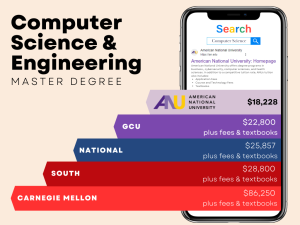
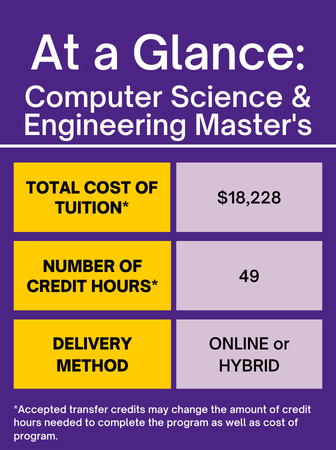
Total tuition for a master’s degree in Computer Science & Engineering at ANU is only $18,228. Large online colleges with course-based programs are 25% – 373% higher and do not include fees or textbooks.(1) ANU tuition includes all fees (application, course, technology, graduation, etc.), textbooks, and lab equipment (where applicable).

Course Information

Master of Science in Computer Science Engineering: 49 Credits

GLOBAL LEARN CLASSES

MSCE Courses

OFFERED TIMES

8 hours, once per term on Saturday

In-person Residency is 3 days per term on Friday, Saturday, and Sunday (For International Students only)

Program Core: 49 Credits

In this course, students acquire information retrieval skills and research competencies to identify and evaluate industry-relevant sources of information for the purposes of analysis and research information security. Students compare and contrast the utility of publicly available and subscription-based information sources for the purposes of meeting academic and professional requirements.

(Co‐Req. RM525) In this course, students will explore database design, development, data warehousing, and the usage of data specification. Students will explore how to generate, patch, and reverse engineer databases utilizing the Entity Relationship Diagram (ERD). This course also includes Best Practices in database design and management as well as usage of data specifications.

(Pre-Req. RM525) In this course, students will explore computer architecture and various operating systems. Students will explore processing, storage, networking, monitoring, and the inner workings of how operating systems are configured and communicate with other computers and server-based systems.

(Pre-Req. RM525) In this course, students will learn how to apply the best practices for large-scale software system engineering, including information security, user interface, architectural design, system models, verification, and validation. Students will strengthen their technique and deepen their understanding of high-level languages and system programming.

(Pre-Req. RM525) In this course, students explore the eight domains of the (ISC)2 Certified Information Systems Security Professional (CISSP) Common Body of Knowledge (CBK) in information security as a framework to critically analyze security awareness issues and to evaluate best practices in implementing security systems within the enterprise.

(Pre-Req. RM525) In this course, students evaluate the principles, attributes and processes used in designing and deploying a comprehensive and resilient layered security architecture that supports the business and technical objectives of the enterprise.

(Pre-Req. RM525) In this course, students utilize PMI’s Project Management Body of Knowledge (PMBOK) as a framework, to apply project management concepts in the information security arena. Each student develops a project plan for a security assessment, which incorporates the technical and behavioral characteristics of high-performance teams.

(Pre-Req. RM525) This course is designed to help students with an understanding of various methods of networking and telecommunications. The course with start with a basic foundation of networking. Topics to be covered include signal generation and analysis at the physical layer, Ethernet and WLAN performance, IP addressing and management, IP router generation, TCP connection control, and packet filtering. While the main focus of this course covers various methods of networking and telecommunications, software tools and techniques will also be examined.

(Pre-Req. RM525) This course is designed to help students to understand distributed system application in today’s business environment. Topics covered include peer-to-peer sharing, collaborative computing, interactive services, and distributed computing. Students will also learn the underlying principles associated with distributed systems. These principles include processes, communication, security, fault tolerance, synchronization and naming conventions. By the end of this course, students will have a fundamental understanding of distributed computing and will have the understanding necessary to develop distributed systems and applications.

(Pre-Req. RM525) This course is designed to provide students with an understanding of the concepts of Cloud computing and its capabilities. The capabilities covered include Cloud service model infrastructures such as Infrastructure as a Service (Iaas), Platform as a Service (PaaS), Software as a Service (SaaS), and Business Process as a Service (BPaaS). This course will also include the security aspects of Cloud computing and the associated challenges. Configuration and implementation of IaaS services will also be discussed in this course.

(Pre-Req. RM525) Big Data Analytics provides an introduction to business intelligence and analytics. Big Data Analytics include the use of data, statistical and quantitative analysis and evidence-based methods to inform business decisions. This course is designed to help students gain an understanding of Big Data Analytics. Students will learn how to deploy Big Data applications in both a desktop and business setting. Some of the concepts discussed include Big Data Storage, processing, analysis, visualization, and applications. Students will also explore social and security issues associated with Big Data.

(Pre-Req. RM525) In this course, students will develop a comprehensive, synthesizing project that applies the knowledge and skill set that has been learned in previous course work that comprises the software development program. Projects must have an academic and an applied component.

Review the TECHNOLOGY REQUIREMENTS for blended and online programs.

Dr. Richard Lightcap

Dean of Information Technology Programs

 Build the foundation of your goals at American National University.

Translate »