

Choose Your Path

I am looking to earn my

Master of Science in Information Technology  

Classroom to Career

The Master of Science in Information Technology program at American National University is designed for professionals seeking to advance their technical expertise and decision-making capabilities in today’s dynamic IT environments. Offered in a flexible online format, the program prepares students to build strong critical thinking skills that support sound professional judgment and effective problem solving across a wide range of information technology contexts. Students learn to design and implement technology solutions that align with organizational needs while developing a solid understanding of the theoretical methods, principles, and tools that underpin the modern IT industry. The curriculum emphasizes the integration of core IT domains, including systems engineering, computer networking, database technologies, web development, IT governance and strategy, and information assurance, enabling graduates to evaluate and manage complex enterprise technology environments. To further support career advancement and industry relevance, the program offers an elective option, CY501, which aligns with ISC2’s CISSP certification and strengthens knowledge of cybersecurity governance, risk management, and enterprise security. Graduates of the Master of Science in Information Technology program are well prepared to pursue advanced technical and leadership roles that require both broad IT knowledge and the ability to apply technology strategically within modern organizations.

Upon completion of the Master of Science in Information Technology program, you should be able to:

  • Build a foundation of critical thinking skills on which to make professional judgments relating to information technology.
  • Design and implement solutions aligned with information technology needs.
  • Solidify an understanding of theoretical methods, principles, and tools used in the information technology industry.
  • Examine the fundamental information technology issues and processes in today’s organizations relating to systems engineering, computer networking, database technologies, IT governance and strategy, Web development, and information assurance.

Check out our “Not-What-You-Would-Expect” Guide to Technology to learn more about this high-demand field.
Online Tuition Comparison

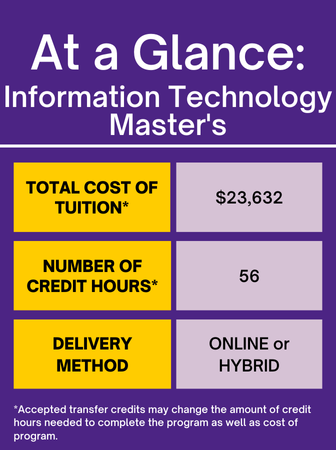
Total tuition for an master’s degree in Information Technology at ANU is only $23,632. Large online colleges with course-based programs are 7% 47% higher and do not include fees or textbooks.(1) ANU tuition includes all fees (application, course, technology, graduation, etc.), textbooks, and lab equipment (where applicable).

Course Information

Master of Science in Information Technology (MS-IT): 56 Credits

GLOBAL LEARN CLASSES

MS-IT Courses

OFFERED TIMES

8 hours, once per term on Saturday

In-person Residency is 3 days per term on Friday, Saturday, and Sunday (For International Students only)

Program Core: 36 Credits

This course covers the advanced fundamentals of database application development using C++, C, or Java by accessing a transaction‐oriented database server. A commercial database environment such as Oracle is used. Optional topics may include enabling access to database via the web and administering large databases.   

This course surveys the various levels of a packet‐switched computer network, using the TCP/IP protocol suite as the primary model. Other network protocol stacks (e.g., Novell) may also be considered as time permits. At the Physical and Data Link Layers, various protocols are compared, and their implications for network topology are considered. At the Network Layer, a wide variety of routing protocols and name resolution protocols are studied. At the Transport Layer, students are introduced to the various methods for building end‐to‐end reliability on top of lower layers. Finally, at the Application Layer a variety of standard protocols such as telnet, ftp, and electronic mail are examined, together with the related issues of security and authentication. Some programming in the C language is required.  

This course will involve a discussion of the methods and tactics used to keep attackers at bay as well as the mechanisms by which organizations can identify and potentially stop potential “bad guys.” The course will involve the following topics as they all relate to the overall security posture: Encryption, authentication, firewalls, NAT/PAT, restricted access policies, intrusion detection and other security frameworks.

Analysis of mobile history, architecture and applications. Students will examine design principles for creating usable and accessible mobile applications. Students will develop technical skills and apply industry standards.  

  Examination of the systems approach to the design and development of information systems. Methods and tools for the analysis and modeling of system functionality (e.g., structured analysis) and data represented in the system (e.g., object‐oriented analysis) are studied.  

The goal of the course is to examine the current theories, practices, tools and techniques in data mining. Many topics and concepts in data mining are learned most efficiently through hands‐on work with data sets, students will spend time with software analyzing and mining data.  

In the Data Warehousing course, students will examine how data warehouses are used to help managers successfully gather, analyze, understand and act on information stored in data warehouses. The components and design issues related to Cloud Based data warehouses and business intelligence techniques for extracting meaningful information from data warehouses are emphasized. Oracle tools will be used to demonstrate design, implementation, and utilization issues.

Examines the evolution, implications and complications of social media in multiple spheres of life including sociality, community, politics, power and inequality, education, and information from theoretical and empirical perspectives.  

Study of design and implementation of dynamic Web pages and applications using both client and server side configuration and programming. Example topics include PHP, Ruby on Rails, and JavaScript.

Electives (Select 5): 20 Credits

This course provides the student with the basis and tools necessary to develop a business case for information assurance governance, and the development and implementation of a strategy to increasingly integrate assurance functions to improve security, lower costs, and ensure the preservation of the organization and its ability to operate.

This course provides students with a strong understanding of the unique marketing challenges that surround innovation and high‐tech products and services. Students will learn how traditional marketing strategies and programs must be modified and adapted for today’s global high‐tech environment and how to bring together marketing with other business disciplines such as research and development, legal and management and strategy to achieve effective cross‐functional interactions.  

Students will learn to develop a complete, comprehensive methodology and framework for adopting and managing a successful service oriented architecture environment and how to set up an SOA Architecture practice defining the policies, procedures and standards that apply to IT developers and the enterprise for business applications.

In this course, students will examine both historical and current perspectives on IT products and services outsourcing, the continuously evolving outsourcing marketplace, and the incentives and opportunities that drive management decisions on IT products and services outsourcing. Contributing factors to IT products and services outsourcing and offshoring market evolution such as globalization, technological advancement, politics, changing global economies, and changing vendor characteristics will be examined. Within this context, students will review different IT products and services outsourcing framework, models, vendor selection strategies, and outsourcing lifecycle from both client and vendor viewpoints.  

This course is an introduction to the application of various statistical concepts and methods as decision support tools to support decision making in technology management. The emphasis is on business application rather than mathematical concepts or problem solving. Students will learn to use statistical tools and quantitative analysis for forecasting, process, and quality management.

Hours   Students taking this course will learn how managers can apply Information Technology to integrate data in business activities to solve management problems, increase productivity, facilitate decision‐ making, and find new opportunities for their organizations.

This research course provides students with an introduction to research for business. Topics covered will include: theory, analysis and application of research techniques; processes and methods for collecting information; developing and utilizing research information for interpretation, judgment, decision‐making, and development of business strategies. This course will focus on applied business research in directed and independent numerical assessment, will integrate research and analysis with available statistical software, and will provide techniques for communicating results in meaningful and effective ways.  

Students taking this course will examine the practices, processes, and concepts of project management. Students will review the project life cycle areas including Initiating, Planning, Executing, Controlling, and Closing projects.  

Note(s):

American National University has incorporated industry-standard cloud computing into the Master of Science in Information Technology program through membership in the Amazon Web Services (AWS) Academy. Through ANU’s membership in this prestigious program, students will have access to up-to-date cloud releases and best practices, hands-on experience, practice exams, and more.

Several ANU professors are fully trained and certified in Academy Cloud Foundations to prepare students for their own AWS certifications. Over the course of an intensive 4-day instructor-led residency, students will receive an introduction to components of AWS in a live computing environment. Students will receive a solid foundation of cloud computing technologies and will gain the understanding required to assess the business and technical elements of the software.

All course prerequisites must be satisfied prior to admission to the program.

For program disclosure information, please visit https://an.edu/about-us/consumer-disclosure

Review the TECHNOLOGY REQUIREMENTS for blended and online programs.

Dr. Richard Lightcap

Dean of Information Technology Programs

 Build the foundation of your goals at American National University.

Translate »