
Choose Your Path

I am looking to earn my


Master of Science in Cybersecurity  

Classroom to Career

The Master of Science in Cybersecurity program at American National University is designed for professionals seeking to advance their careers in cybersecurity, risk management, and security leadership across today’s complex digital environments. Offered in a flexible online format, the program equips students with the critical thinking and professional judgment skills needed to analyze cybersecurity challenges, design and implement effective security solutions, and apply industry-standard frameworks, tools, and methodologies. Students develop a strong theoretical and practical foundation in cybersecurity principles while examining how security integrates with systems engineering, networking, databases, web technologies, governance, and information assurance within modern organizations. The curriculum is intentionally aligned with leading industry certifications to enhance career readiness and employer recognition. Core courses include MSC510, which aligns with ISC2’s CISSP certification to reinforce enterprise security, risk, and governance competencies, and MSC550, which aligns with PMI’s PMP certification to strengthen project leadership and execution skills in security initiatives. Elective options allow students to further specialize, including advanced CISSP alignment through CIS525, management-focused security leadership aligned with ISACA’s CISM in CSM535, secure software development aligned with ISC2’s CSSLP in CSP545, offensive security and penetration testing aligned with CEH and Licensed Penetration Tester credentials in CHP555, business continuity and resilience aligned with DRI International’s Certified Business Continuity Professional in CBC575, and digital forensics aligned with the Certified Forensic Computer Examiner credential in CFE565. Together, these learning experiences prepare graduates to make informed security decisions, design and defend robust cybersecurity solutions, and pursue advanced roles in cybersecurity engineering, management, and leadership within diverse organizational environments.

Upon completion of the Master of Science in Cybersecurity program, you should be able to:

  • Build a foundation of critical thinking skills on which to make professional judgments relating to Cybersecurity.
  • Design and implement solutions aligned with Cybersecurity needs.
  • Solidify an understanding of theoretical methods, principles, and tools used in the Cybersecurity industry.
  • Examine the fundamental information technology issues and processes in today’s organizations relating to: systems engineering, computer networking, database technologies, IT governance and strategy, Web development, and information assurance.

Check out our “Not-What-You-Would-Expect” Guide to Technology to learn more about this high-demand field.
Online Tuition Comparison

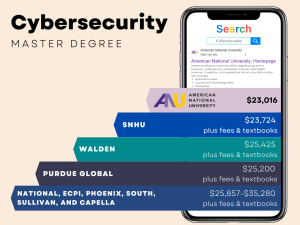
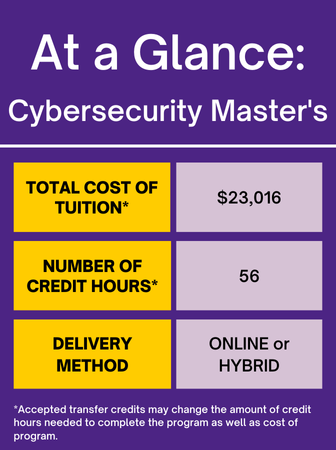
Total tuition for an master’s degree in Cybersecurity at ANU is only $23,016. Large online colleges with course-based programs are 3% – 53% higher and do not include fees or textbooks.(1) ANU tuition includes all fees (application, course, technology, graduation, etc.), textbooks, and lab equipment (where applicable).

Course Information

Master of Science in Cybersecurity (MSC): 56 Credits

GLOBAL LEARN CLASSES

MSC Courses

OFFERED TIMES

8 hours, once per term on Saturday

In-person Residency is 3 days per term on Friday, Saturday, and Sunday (For International Students only)

Program Core: 44 Credits

Hours   In this course, students will be introduced to the eight domains of the (ISC) 2 Common Body of Knowledge (CBK) in information security. These domains will be used as a framework to analyze critically security awareness issues and to evaluate best practices in implementing security systems within the enterprise.  

In this course, students examine common attack methods, technologies, and countermeasures. Students also gain skills needed to recognize various stages and methods of attack on the enterprise.  

In this course, students analyze the principles of change management as they apply to the requirements and regulations of information security. Students evaluate the factors that affect corporate decision‐making when implementing security programs and the ability of the manager to translate corporate needs into information security projects.

This course provides students with an overview of risk management principles. Methods to identify, quantify, and qualify internal and external risks to the organization are examined. Students apply these principles and methods to the current business and risk environment.  

In this course, students utilize PMI’s Project Management Body of Knowledge (PMBOK) as a framework to apply project management concepts in the information security arena. Each student develops a project plan for a security assessment, which incorporates the technical and behavioral characteristics of high performance teams.  

In this integrative course, students’ asses the information security risk associated with an identified management problem. Students then develop a risk mitigation strategy which integrates principles and techniques of risk analysis, project planning and change management.  

In this course, students transform high‐level policies and procedures into quantifiable and measurable controls and mechanisms that enforce data and process integrity, availability and confidentiality.  

In this course, students examine the role of security policies, standards, and procedures in addressing business and technical risks and develop a security governance report to evaluate compliance across the enterprise.  

This course provides students with the expertise and skills in development of information assurance policies and deployment plans as part of the comprehensive strategic plan and operational objectives of the enterprise.

In this course, students evaluate the procedures and results of risk analysis, as well as the compliance processes that address the regulatory requirements, which drive the need for risk analysis within the enterprise. Security‐related regulations such as SOX, GLBA, FISMA, and HIPAA are examined.  

In this course, students analyze an enterprise‐wide view of information systems and the establishment of appropriate, cost‐effective information protection programs. Within this context, students examine a set of standard policies, procedures, activities and a management structure to certify and accredit information systems for the protection of the data as well as the systems.

Electives (Select 3): 12 Credits

(Prereq. MSC560) In this course, students will draw on their knowledge on (ISC)2 Common Body of Knowledge (CBK) or what they learned from MSC‐7500 to dig deeper into the eight domains of the (ISC)2 Common Body of Knowledge (CBK) in information security by evaluating information security case studies and produce real‐life deliverables.

(Prereq. MSC620) The purpose of this course is to help prepare students for a successful career in public practice, industry or government by understanding how to manage, use and participate in the design of information systems. The course will also help students learn how to assess and consider the impact of IT governance, risk and compliance on accounting functions, focusing on how IT affects business processes and controls. This course serves as a preparation course for the Certified Information Systems Manager (CISM) exam certification.  

In this course, students will be introduced to the eight domains of the (ISC)2 Common Body of Knowledge (CBK) in secure software development. These domains will be used as a framework to critically analyze information security and assurance awareness issues in software development and to evaluate best practices in implementing security and assurance concepts systems in the Software Development Lifecycle.

(Prereq. MSC640) This course analyzes the principles and techniques associated with the cybersecurity practice known as penetration testing. The course covers planning, reconnaissance, scanning, exploitation, post‐exploitation, and result reporting and prepares students for the Licensed Penetration Tester (LPT) and Certified Ethical Hacker (CEH) certifications.  

This course on business continuity planning (BCP) explores strategies and methods for BCP and recovery activities consistent with ISO 22301:2012, business continuity management systems, and the Disaster Recovery Institute International’s 10 Professional Practice Subject Areas for the Certified Business Continuity Professional (CBCP) credential. Topics include (a) program initiation and management; (b) risk evaluation and control; (c) business impact analysis; (d) emergency response and operations; (e) BCP implementation and documentation; (f) BCP exercise, audit and maintenance; (i) with external agencies; and (j) business continuity strategies, including awareness and training programs (4 credits).  

This course uses the 9 domains of the CCFE as the foundation to educate students in the field of Computer Forensics and to provide the necessary skills to the student so they can be an effective Computer Forensics Investigator. The skills learned in the course will include practical skills for hands‐ on computer forensics investigations as well as preparation skills for legal examination and chain‐of‐ custody delivery under the Federal Rules of Civil Procedure. Additionally, the student will learn detailed techniques for examining digital evidence from computer equipment to mobile phones and any device that deals with a microprocessor.  

Note(s):

Review the TECHNOLOGY REQUIREMENTS for blended and online programs.

All course prerequisites must be satisfied prior to admission to the program.

For program disclosure information, please visit 

Consumer Disclosure

Dr. Richard Lightcap

Dean of Information Technology Programs

 Build the foundation of your goals at American National University.

Translate »