
Choose Your Path

I am looking to earn my


 Cybersecurity Bachelor’s

Classroom to Career

The Cybersecurity Bachelor of Science degree program at American National University prepares graduates for careers in enterprise network security and security administration and management within government and industry organizations. The program focuses on protecting physical and information assets from unauthorized access, malicious cyberattacks, and corporate or government-sponsored espionage. Students develop a strong foundation in the principles and methods of cybersecurity while gaining practical skills in security and vulnerability assessment, threat analysis, and the implementation of network and infrastructure defense mechanisms. The curriculum also addresses advanced and emerging areas of cybersecurity, including biometric technologies, computer forensics, incident response, and disaster recovery, ensuring graduates are prepared to respond effectively to security incidents and organizational risk. Coursework is aligned with industry-recognized certifications, including CompTIA A+ through IT101 and IT102, CompTIA Network+ through IT110 and IT111, and CompTIA Security+ through CY200, reinforcing essential competencies in systems, networking, and cybersecurity fundamentals. Advanced infrastructure and server security skills are further developed through Windows Server 2022 coursework in NET205, NET227, and NET228. Graduates of the program are well prepared to begin entry-level careers as information assurance specialists, network security administrators, or network security analysts, with the technical knowledge and applied skills required to defend modern enterprise environments.

Upon completion of the Cybersecurity Bachelor’s program, you should be able to:

  • Demonstrate a strong foundation in the principles and methods of Cybersecurity.
  • Apply security measures across a variety of network architectures and settings.
  • Begin an entry‐level career as an information assurance specialist, network security administrator, or network security analyst.
  • Demonstrate skills in security and vulnerability assessment, threat analysis, network and infrastructure defense mechanisms, biometric technologies, computer forensics, and incident response and disaster recovery.
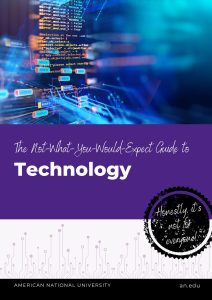
Check out our “Not-What-You-Would-Expect” Guide to Technology to learn more about this high-demand field.
Online Tuition Comparison

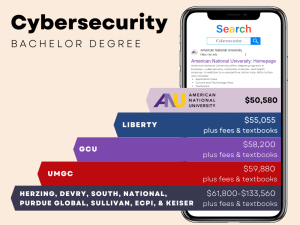
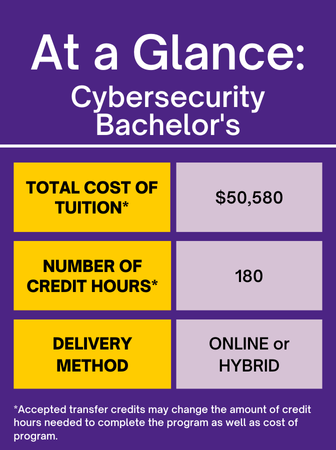
Total tuition for a bachelor’s degree in Cybersecurity at ANU is only $50,580. Large online colleges with course-based programs are 8% – 164% higher and do not include fees or textbooks.(1) ANU tuition includes all fees (application, course, technology, graduation, etc.), textbooks, and lab equipment (where applicable).

Course Information

Cybersecurity Bachelor’s (CSYB): 180 Credits

GLOBAL LEARN CLASSES

Cybersecurity Courses

OFFERED TIMES

2 Hours Every Other Week

Evening classes are scheduled between 6 and 10 pm, EST

In-person Residency is twice per term, with each session lasting 3 days (for International Students only)

Program Core: 124 Credits

  • BUS270 Introduction to Project Management
  • COM151 The Microsoft® Office
  • CS105 Introduction to Relational Database Management Systems
  • CS120 Introduction to Python
  • CS125 Introduction to Artificial Intelligence and Machine Learning
  • CS250 Systems Analysis & Design
  • CY200 Security+
  • CY300 Physical and Technical Security
  • CY302 Mobile Security
  • CY310 Principles of Incident Response & Disaster Recovery
  • CY320 Cyber Security Law and Ethics
  • CY325 Biometrics: Application, Technology and Management
  • CY350 Information Security Fundamentals
  • CY375 Computer Forensics
  • CY410 Ethical Hacking and Network Defense
  • IT101 Implementing and Troubleshooting OS Technology
  • IT102 Computer Hardware Technology
  • IT110 Network I
  • IT111 Network II
  • IT125 Introduction to Cloud Technology
  • IT215 Client Configuration I
  • IT216 Client Configuration II
  • IT315 Application Development
  • IT335 Principles of Cryptography
  • IT400 Information Security Governance
  • NET205 Windows Server Administration I
  • NET227 Network Server Installation and Configuration
  • NET236 Introduction to Firewalls and Network Security
  • NET298 Network Administration Certification and Career Success
  • NET310 Implementing Collaborative Services
  • CY499 Cybersecurity Externship and Capstone

Experiential Learning

Upon completion of one academic year (three full-time quarters), students apply to pursue Experiential Learning. With Experiential Learning, students are required to maintain professional experience of at least five (5) work hours per week related to their fields of study during their enrollment. Successful entry into Experiential Learning requires an attestation from both the student and the student’s supervisor, indicating the average number of hours planned to work each week and the expected duration of the work experience. Students should consult their Academic Advisors prior to starting their Experiential Learning

Written and Oral Communication

ENG102 English Composition*

ENG126 Oral Communication

Mathematics, Statistics, and Logic

LOG215 Thinking Critically

LOG357 Logic and Critical Thinking*

MAT101 Understanding Mathematics

MAT220 Algebra and Basic Statistics

MAT214 Algebra*

MAT419 Introduction to Statistics

Arts and Humanities

ETH205 Ethics

GEN241 Cultural Appreciation

REL330 World Religion

Social and Behavioral Sciences

GOV340 American Government

HIS290 American History 1945–Present

HIS490 American Economic History

POL202 Political Science

PRO453 Parliamentary Procedures/Group Dynamics

PSY127 Psychology*

PSY200 Human Growth and Development

SOC103 General Sociology

SOC463 Social Problems

Physical/Natural Science

BIO101 Introduction to Biology

ENV101 Environmental Science

PER330 Personal Health

Note(s):

For all courses: See course description for applicable prerequisites.

* This program requires this General Education course or equivalent

For program disclosure information, please visit https://an.edu/about-us/consumer-disclosure

Review the TECHNOLOGY REQUIREMENTS for blended and online programs.

Dr. Richard Lightcap

Dean of Information Technology

Welcomes you to the Information Technology Department.

 Build the foundation of your goals at American National University.

Translate »